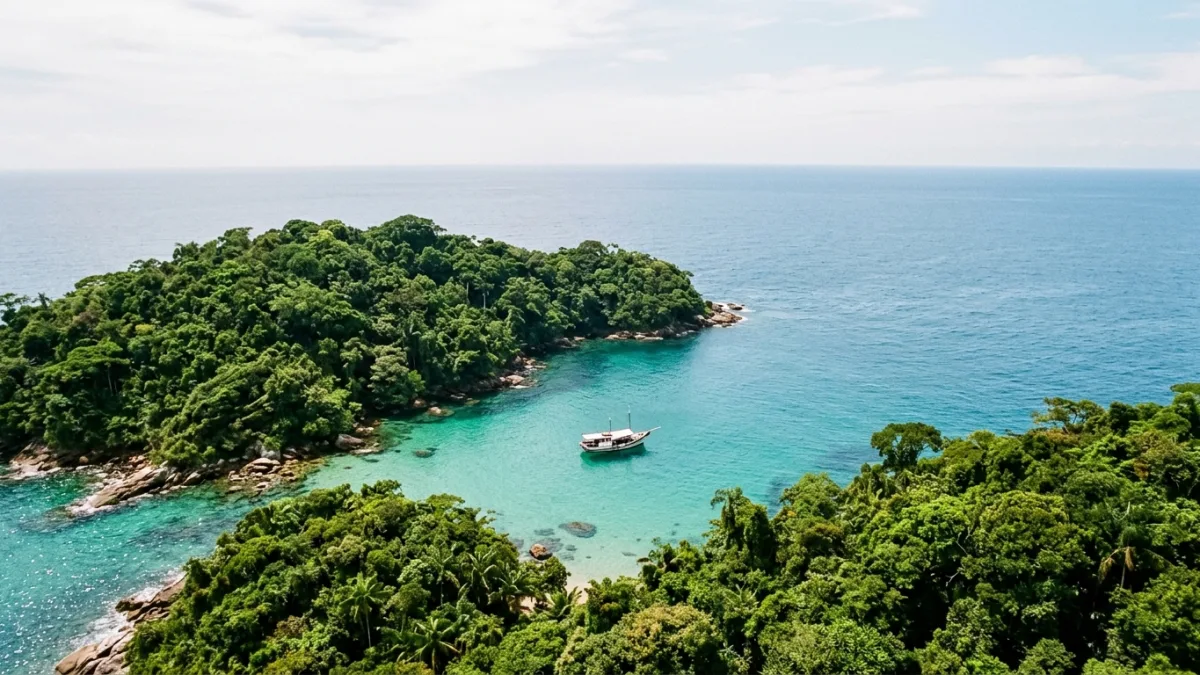
Beaches and islands in Brazil: one coast, very different seas
Brazil has thousands of kilometres of coast, and treating it as one destination is the commonest mistake. The sea is warm all year in one half of the country and genuinely cold in the other, and the rainy months fall at opposite times.
Not one coast, but several
From the equator to below the tropic, the Brazilian coast changes character several times. In the north-east the sea is warm all year and reef lines form shallow pools at low tide. In the south-east the Atlantic forest comes down to the water and the coast breaks into hundreds of small bays separated by headlands. In the south the water turns cool, the surf becomes consistent and the beaches empty outside summer.
Those are not variations of the same holiday. A traveller who books the south expecting Caribbean water, or the north-east expecting empty sand, has chosen the wrong half of the country.
Reef pools and the tide
Where a reef line runs parallel to the shore, the falling tide leaves clear, shallow pools between the reef and the beach. It is the image most associated with the north-east — and it comes with a condition that catches people out: the pools exist at low tide, not all day.
Anyone travelling for that specific scene needs the tide table for their dates, not just the forecast. It is also why those sites have visitor limits and rules about sunscreen and walking on the reef: a reef is a living structure and does not survive being stood on.
Islands and how you reach them
Offshore there are large inhabited islands reached by ferry, small uninhabited ones visited by schooner or water taxi, and a few remote archipelagos with strict visitor limits. On most of the coast the clearest water is on the islands rather than on the mainland beaches, because the mainland is closer to river mouths and towns.
Boat trips depend on weather and are cancelled regularly. Planning a single day for the boat in a short stay is how people end up not doing it at all.
When each stretch is at its best
Stretch
Sea
What to watch
North-east
Warm all year
Rain around mid-year; a windy season in the second half
South-east
Warm in summer, cool in winter
Rain and crowds both peak in January and February
South
Cool to cold
Season decides whether swimming is pleasant at all
Currents, and asking locally
Currents vary sharply along the same beach, and lifeguards are not present everywhere or all year. Asking locally which stretch is safe for swimming on the day is normal practice, not excessive caution — the answer changes with the swell.
The north-east has the warmest sea in Brazil and the longest stretch of coast, and it is far from uniform: reef pools in one state, towering dunes in another, a
The Costa Verde is a coast of sheltered bays and hundreds of islands between Rio de Janeiro and São Paulo, backed by forested mountains and dotted with colonial
The south of Brazil has a coast most foreign visitors never consider: cooler water, serious surf, island interiors of Atlantic forest and beaches that are genui
The São Paulo coast is where the Atlantic forest comes down to the water: hundreds of small beaches separated by headlands, islands offshore and waterfalls a fe