The same limestone that clears the rivers of Bonito, in Mato Grosso do Sul, hollowed out the ground beneath them. Some caves you walk into; one you descend into on a rope; and all of them are the day that rain cannot take from you.
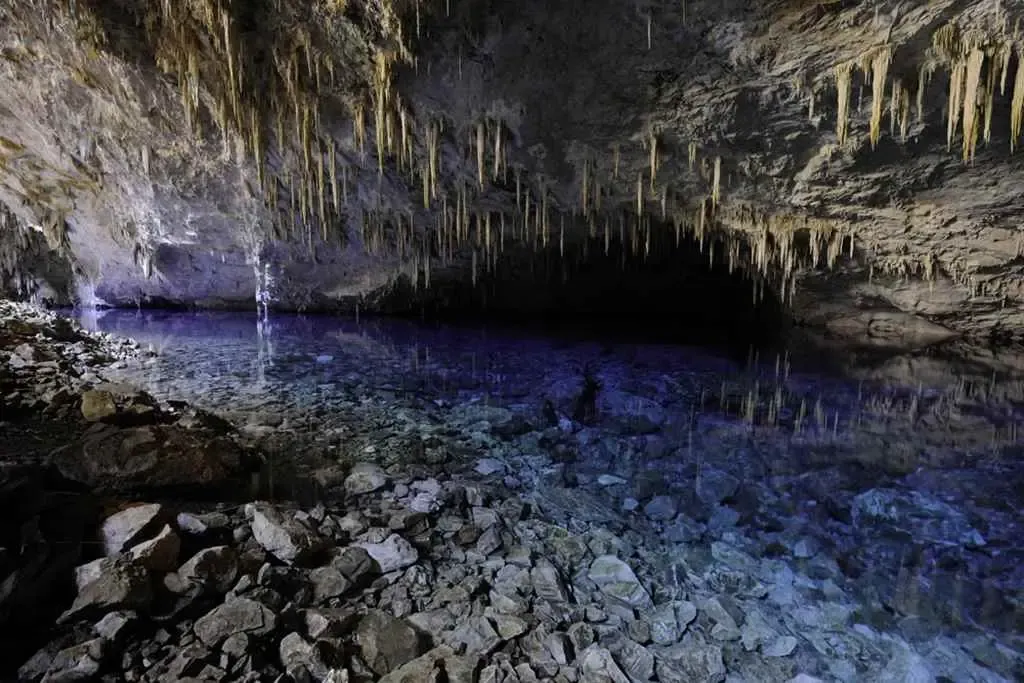
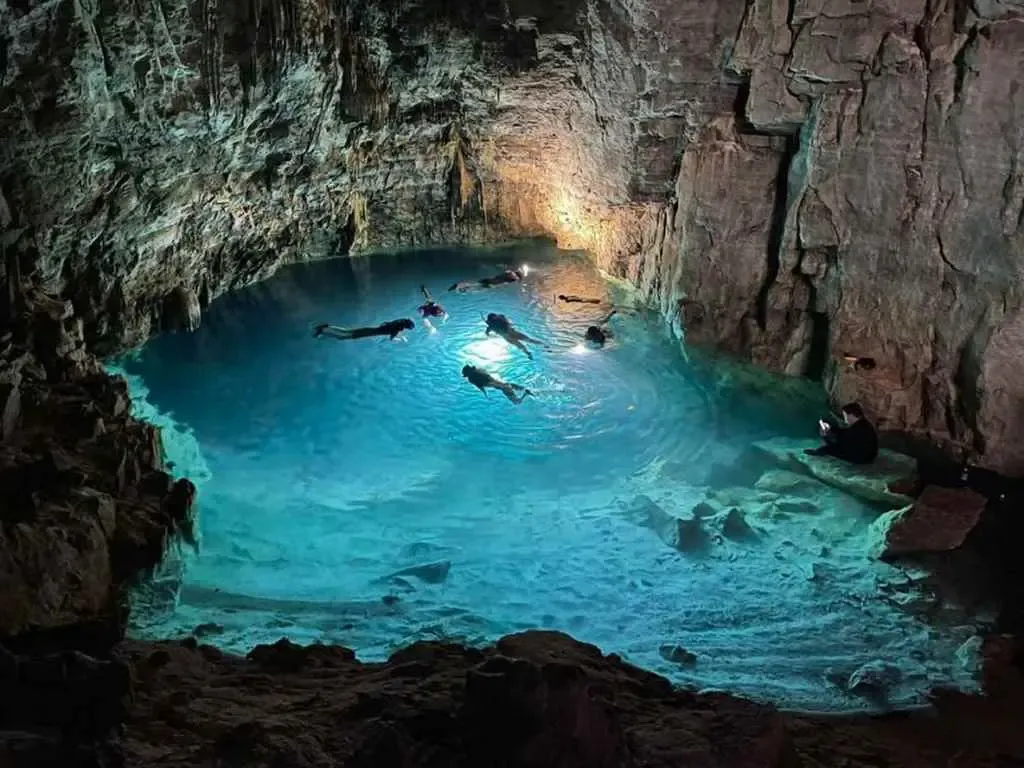
Gruta do Lago Azul, the cave that gave Bonito, MS its best known image.
The caves of Bonito, MS are the other half of what the limestone built. The same rock that filters the rainwater and gives the rivers their clarity was dissolved from underneath over a very long time, leaving chambers, sinkholes and flooded halls beneath the farmland.
Five of them are open to visitors, and they are not variations on one another. Two you walk into on foot along built walkways, one you descend into on a rope, one you float inside with a mask, and one is a large dry hall where the scale of the room is the whole point.
They are also the most weather-proof attraction in the municipality. When rain clouds the rivers and closes the flotation, the caves are unaffected — which is why a well built trip keeps one of them in reserve rather than booking it on a fixed day.
Why there are so many caves here
Rainwater picks up carbon dioxide as it passes through soil and becomes mildly acidic. Over hundreds of thousands of years that slightly acidic water dissolves limestone along cracks in the rock, widening them into passages and then into chambers.
Where a chamber grows large enough, its roof collapses and leaves a sinkhole open to the sky — which is what the Buraco das Araras and the Lagoa Misteriosa are. Where the water table sits above the floor, the chamber floods and you get the underground lakes that Bonito is known for.
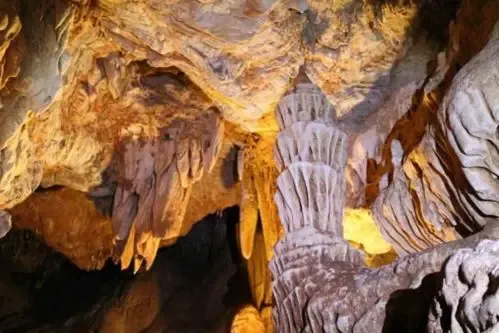
The formations inside — stalactites hanging from the ceiling, stalagmites growing from the floor, and the columns where the two have met — are the same process running in reverse: water depositing the mineral it dissolved upstream. They grow slowly enough that touching one is not a small thing, which is why the walkways exist and why guides enforce them.
Dry caves and flooded caves
The practical division is between caves you walk into and caves you enter in the water, and it decides almost everything about the day:
Dry caves — built walkways, a guided walk, no equipment beyond footwear with grip, and a visit that takes a morning including the transfer.
Flooded caves — a wetsuit and a mask, sometimes a rope descent, always a briefing, and real requirements on age and health.
Sinkholes open to the sky — viewed from the rim rather than entered, and often more about the wildlife that nests in them than about the rock.
Effort — the dry caves ask for stairs and balance; the flooded ones ask for comfort with heights, with confined space or with both.
Booking — every cave needs a voucher and most need an accredited guide, exactly as the rivers do.
One of each kind is the sensible allocation for a trip of three or four days. Two dry caves in a row tends to blur into one memory rather than two, in the same way two flotation rivers do.
Gruta do Lago Azul
The image most people already have of Bonito, MS. You descend on stone steps into a large chamber holding a lake whose blue comes from sunlight reaching the water through the entrance at a particular time of the morning. It is a protected natural monument, and access is controlled accordingly.
The descent and the climb back out are the physical part of the visit, on uneven steps that are wet and slippery in places. There is no swimming and no boat: you look at the lake from a platform, and that is the whole visit, which takes a morning once the transfer is counted.
Go early. The colour depends on the angle of the light, so the first slots of the day are the ones that show the lake as the photographs do. Later in the morning the chamber is still impressive, but the blue people come for is weaker.
Gruta de São Miguel
The most accessible cave in the region, on a raised walkway that runs between the formations rather than past them. If steps and uneven ground are a problem for anyone in the group, this is the cave to choose, and it does not feel like a compromise.
The visit is guided and short, which makes it the natural second half of a day that began on a river. It is also the best place here to have the formations explained: the guides use the walkway to show how stalactites, stalagmites and columns relate to one another.
A suspension bridge on the approach is the part most visitors photograph on the way in, and there is usually a short forest walk attached. Comfortable for children, comfortable for older visitors, and comfortable in rain.
Gruta Catedral
A large dry chamber where the scale of the room is the point rather than water. The formations are dense, the ceiling is high, and the lighting is arranged to show the height rather than to flatter individual features — which is where the name comes from.
It is a straightforward walking visit with a guide, on a route that asks for no technique and no equipment beyond shoes that grip. Allow a morning with the transfer, and expect the temperature inside to be noticeably steadier than outside.
Pair it with a river in the morning rather than with another cave. Two dry caves on the same day is the most common way to make both of them forgettable.
Abismo Anhumas
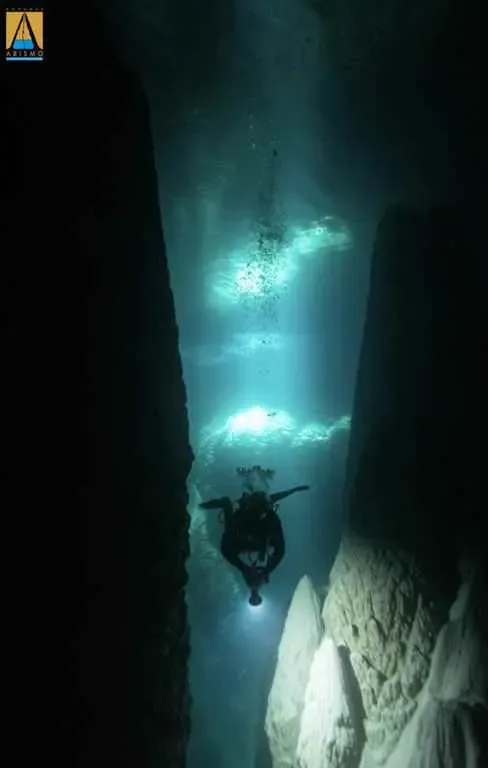
The one you descend into on a rope. Entry is by abseil through a narrow opening in the ground into a chamber holding a lake, and once you are down there you either float on the surface with a mask or dive it, if you hold a diving certification.
This is not a casual booking. There is compulsory abseiling training on the day before, held at a tower in town, and you cannot do the descent without it. The climb back out is on an ascender and is the part people underestimate.
Operators apply requirements on age, weight and health condition, and those requirements change. Confirm them directly when you book rather than on the morning, particularly if anyone in the group has a relevant condition or is uneasy with heights or confined spaces.
Gruta do Mimoso
A flooded cave where the visit happens in the water rather than on a walkway. You float inside the chamber with the formations above and around you, which is a different sensation entirely from looking at a cave from a platform a few metres away.
It sits further out than the other caves and takes longer to reach, so it works best as the single fixed point of the day rather than as something added to a morning. Certified divers can go deeper here; everyone else stays on the surface with a mask.
Because the interesting part is under and above you at once, it is the cave that rewards taking your time. It is also the one where the briefing matters most: the rules about what you may touch exist because the formations are still growing.
Choosing between them
If you are visiting one cave, make it the Gruta do Lago Azul. It is the image the region is known for, the visit is straightforward, and seeing it early in the morning is a thing you cannot replicate elsewhere. If mobility is a concern, choose São Miguel instead and you will lose very little.
If you are visiting two, take one dry and one flooded rather than two of the same. The Abismo Anhumas and the Gruta do Mimoso are the two that change what you think a cave is, and both ask something of you — which is exactly why they are worth the slot.
The day rain cannot take from you
Caves are the answer to the question every trip to Bonito, MS eventually asks: what do we do when it rains? Heavy rain clouds the rivers and closes the flotation, sometimes at short notice on the morning itself, and that is when a cave booking becomes the most valuable thing in your schedule.
The dry caves are entirely unaffected by weather outside. The flooded ones are more sensitive, because the water inside can cloud like the rivers do, but they still hold their visibility longer than an open river does.
The practical advice is to book the rivers early in your stay and keep a cave slot free for the back half. That way a cancellation moves into the free slot rather than removing something from the trip, and you finish having done what you came for.
What to bring and what to expect
The properties supply the helmet, the lamp and, where relevant, the wetsuit and harness. What you bring is small, and most of it is about the walk in and the climb back out:
Footwear with grip that can get wet — wet limestone is the single most slippery surface in Bonito.
Clothes you do not mind getting muddy, and a dry change for the drive back.
Swimwear under your clothes for the flooded caves.
Water for the walk, and something to eat if the visit runs into the afternoon.
A camera that copes with low light; flash rarely captures a cave chamber well.
No perfume or heavy repellent in the flooded caves, where it affects the water.
Expect the temperature inside to be steadier than outside and the humidity to be high. Expect your glasses to fog. And expect the guide to ask you not to touch the formations, which is not decoration of a rule: the oils on a hand stop a stalactite growing at the point they touch it.
Bonito, in Mato Grosso do Sul, is the one destination in Brazil where you cannot improvise. Every attraction runs on a booking system with a daily cap, and the
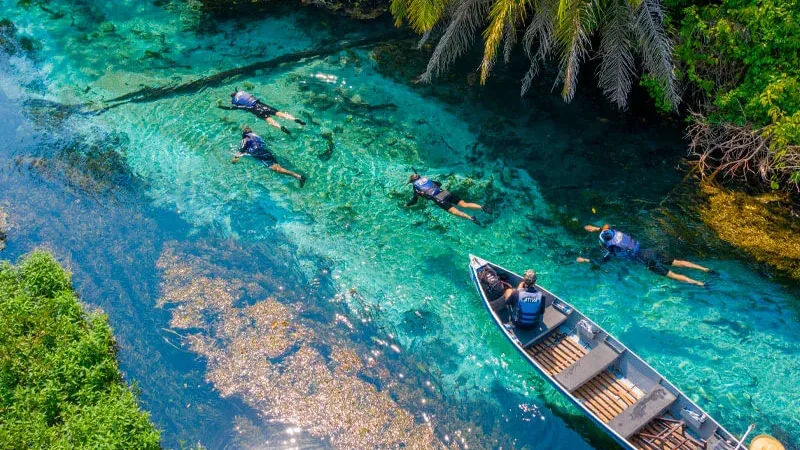
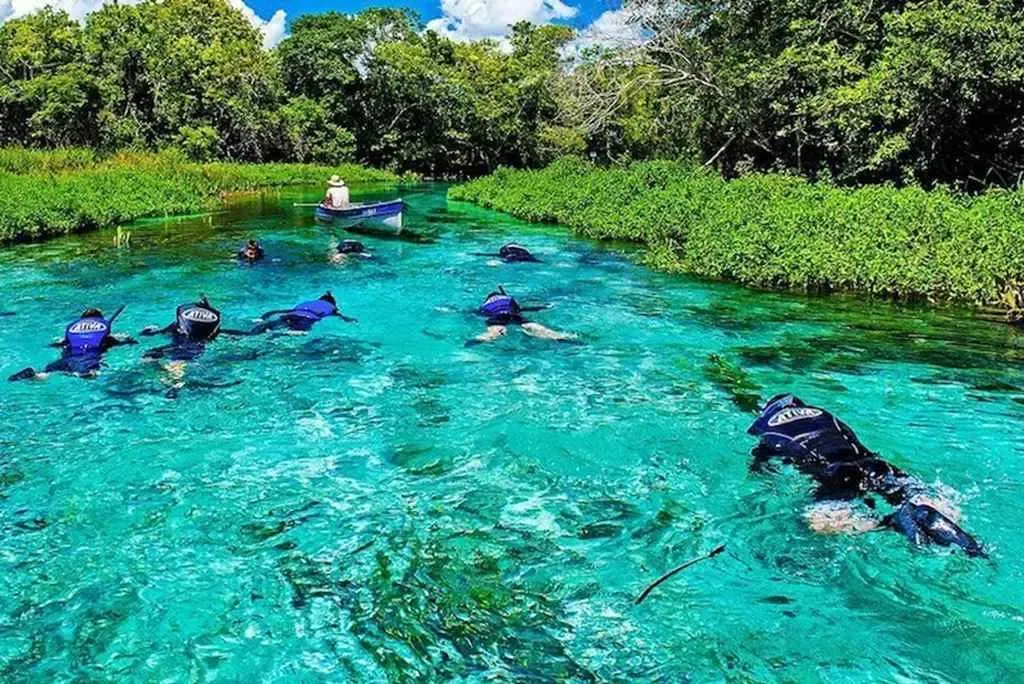
Flotation is what Bonito, in Mato Grosso do Sul, is known for: drifting downstream in a wetsuit and mask, carried by the current. The five rivers differ far mor